
Receiving a blood cancer diagnosis can feel overwhelming, not just medically, but emotionally and logistically. Where should you go? What treatment does your specific type require? How do you separate good information from the noise? This guide exists to answer those questions with clarity.
In Kerala, rising cases of cancers such as leukaemia, lymphoma, and myeloma have made awareness and timely treatment more important than ever. The good news is that advances in diagnostics, targeted therapies, and specialised cancer care have significantly improved outcomes.
This guide explains the key types of blood cancer, available treatment approaches, and what patients and families in Kerala need to know to make informed decisions.
What Is Blood Cancer?
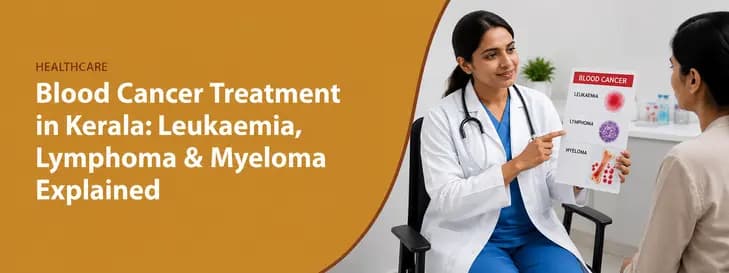
Blood cancer, clinically referred to as haematological malignancy, is not a single disease. It is a family of cancers that originate in the blood, bone marrow, or lymphatic system, disrupting how the body produces and uses blood cells. When abnormal blood cells grow uncontrollably, they crowd out healthy cells, impairing immunity, oxygen delivery, and clotting.
There are three primary categories:
Leukaemia
It develops in the bone marrow and blood, causing an overproduction of abnormal white blood cells. It can be acute (fast-growing) or chronic (slow-growing), and affects both children and adults, though certain subtypes, like Acute Lymphoblastic Leukaemia (ALL), are most common in children under 15. The four main subtypes, ALL, AML, CML, and CLL, each require a different protocol:
- ALL (Acute Lymphoblastic Leukaemia): Most common in children. With modern risk-stratified chemotherapy protocols, paediatric ALL achieves long-term remission.
- AML (Acute Myeloid Leukaemia): The most common acute leukaemia in adults. High-risk cases require intensive chemotherapy followed by bone marrow transplant.
- CML (Chronic Myeloid Leukaemia): Driven by the Philadelphia chromosome. Oral targeted drugs (TKIs like imatinib) have transformed it into a manageable, near-normal-life condition for most patients.
- CLL (Chronic Lymphocytic Leukaemia): Typically slow-growing; often monitored before treatment begins.
Lymphoma
Lymphoma originates in the lymphatic system, the body's infection-fighting network. It is divided into Hodgkin Lymphoma (HL) and Non-Hodgkin Lymphoma (NHL). In India, lymphoma is the most prevalent blood cancer category overall. There are two families:
- Hodgkin Lymphoma (HL): Identified by Reed-Sternberg cells. One of the most curable cancers, early-stage HL has a cure rate of approximately 85–90% with ABVD chemotherapy.
- Non-Hodgkin Lymphoma (NHL): A far more heterogeneous group. Diffuse Large B-Cell Lymphoma (DLBCL), the most common aggressive type, is treated with R-CHOP. Lymphoma is India's most prevalent blood cancer category by total case volume.
Multiple Myeloma
It is a cancer of plasma cells, the white blood cells responsible for producing antibodies. It predominantly affects adults over 60 and involves abnormal plasma cells accumulating in the bone marrow, weakening bones and suppressing normal blood cell production. Each of these has multiple subtypes.
The treatment for Acute Myeloid Leukaemia (AML) differs significantly from Chronic Lymphocytic Leukaemia (CLL) or Mantle Cell Lymphoma (MCL). This is why an accurate subtype diagnosis, confirmed by bone marrow biopsy and molecular testing, is the essential first step before any treatment decision.
Symptoms: When to See a Haematologist, Not a GP
Blood cancers mimic common illnesses, which is why diagnosis is often delayed by months. See a haematologist urgently if you have two or more of the following for more than two weeks:
- Persistent, unexplained fever (no obvious infection source)
- Extreme fatigue and pallor that doesn't improve with rest
- Painless swollen lymph nodes, neck, armpit, or groin
- Night sweats that soak through clothing
- Unexplained weight loss of more than 5kg in six months
- Unusual bruising, or cuts that take much longer than normal to stop bleeding
- Recurring infections, sinusitis, UTIs, chest infections happening repeatedly
- Bone pain in the spine or hips (a characteristic early sign of myeloma)
A routine CBC (Complete Blood Count) is the first test and is available anywhere. Abnormal results, high or low white cell counts, low haemoglobin, low platelets, must immediately trigger a haematology referral, not watchful waiting.


How Is Blood Cancer Diagnosed?
Diagnosis involves a layered process, and no single test is sufficient on its own. A Complete Blood Count (CBC) is usually the first investigation, an abnormal white cell count prompts further testing. A bone marrow biopsy is the gold standard for confirming leukaemia and myeloma.
For lymphoma, a lymph node biopsy is typically required. Beyond these, doctors rely on flow cytometry, cytogenetics (to identify chromosomal abnormalities like the Philadelphia chromosome in CML), FISH testing, molecular markers, CT scans, PET scans, and MRI imaging.
This multi-step diagnostic process is why it matters to seek care at a hospital with a full-spectrum haematology lab, radiology department, and experienced pathologists working in coordination. Results from these investigations collectively define the type, subtype, and stage of the cancer, which directly determines the treatment plan.
Here’s a quick overview of what an investigation cascade includes:
| Test | What It Detects |
|---|---|
| Complete Blood Count (CBC) | Abnormal cell counts, the first alert |
| Bone Marrow Biopsy | Confirms leukaemia and myeloma; identifies blast percentage |
| Lymph Node Biopsy | Required to diagnose lymphoma |
| Flow Cytometry | Identifies exact cell type and maturity of cancer cells |
| Cytogenetics / FISH | Detects chromosomal abnormalities (e.g. Philadelphia chromosome in CML) |
| PCR Molecular Testing | Monitors treatment response in CML; identifies mutations |
| SPEP / Immunofixation | Detects M-protein, the myeloma marker in blood/urine |
| PET-CT / MRI | Stages lymphoma; assesses bone damage in myeloma |
Blood Cancer Treatment Options in Kerala: What's Available
The landscape of blood cancer treatment has changed profoundly over the past two decades. Kerala now has several centres equipped with advanced haematology and oncology infrastructure, particularly in cities like Kozhikode (Calicut), Thiruvananthapuram, and Kochi.
Here is a clear overview of the treatment modalities used:
Chemotherapy remains the backbone of blood cancer treatment. It involves using drugs to destroy rapidly dividing cancer cells. Protocols vary significantly by cancer type, some require intensive inpatient cycles, while others can be administered as day-care infusions. Side effects are managed with supportive medications.
Targeted Therapy uses drugs that specifically attack cancer cells at the molecular level, sparing healthy tissue. Tyrosine kinase inhibitors (TKIs) like imatinib have transformed Chronic Myeloid Leukaemia (CML) from a life-threatening disease into a manageable, near-normal-life condition for many patients.
Immunotherapy harnesses the body's immune system to fight cancer. This includes monoclonal antibodies (like rituximab for lymphoma) and checkpoint inhibitors that remove brakes on the immune response.
CAR-T Cell Therapy (Chimeric Antigen Receptor T-cell therapy) is one of the most significant advances in oncology in recent years. A patient's own T-cells are extracted, genetically engineered to recognise cancer cells, and reinfused. It has shown remarkable results in relapsed/refractory B-cell lymphomas and ALL.
Radiation Therapy is used selectively, particularly in Hodgkin lymphoma and localised NHL, often combined with chemotherapy.
Bone Marrow Transplant (BMT), also called Stem Cell Transplant, is the most intensive option and may be the only curative route for certain high-risk blood cancers. It involves replacing diseased bone marrow with healthy stem cells from either the patient (autologous) or a matched donor (allogeneic).
Blood Cancer Treatment at Meitra Hospital, Kozhikode
Among Kerala's haematology centres, Meitra Hospital in Kozhikode stands out for its structured approach to blood cancer care. The hospital's Centre for Excellence in Blood Diseases, Bone Marrow Transplant, and Cancer Immunotherapy operates as an integrated unit covering haematology, BMT, medical oncology, surgical oncology, and cancer immunotherapy under one department.
The department is led by Dr. Ragesh R. Nair, Director of Haemato-Oncology and BMT, who completed both his MD (Internal Medicine) and DM (Clinical Hematology) from AIIMS, New Delhi, one of India's most rigorous training environments for this specialty. He secured an All-India 8th rank in the nationwide AIIMS entrance and topped the DM Clinical Hematology entrance examination. His academic output includes 17 publications in indexed journals and 6 international book chapters.
The centre offers a dedicated Myeloma Clinic for focused myeloma management, an Immunotherapy Clinic with laboratory and transfusion services, and BMT capabilities using bone marrow, peripheral blood stem cells, and cord blood. It also serves patients with non-malignant conditions like thalassemia, aplastic anaemia, and autoimmune disorders.
The hospital is NABH-accredited and has a dedicated international patient services team that assists with medical visas, accommodation, and language support, an important consideration for patients travelling from the Gulf, Bangladesh, or other parts of South Asia.
That said, blood cancer treatment decisions should always be made on the basis of your specific diagnosis, your doctor's clinical assessment, and your personal circumstances. The right centre for you depends on your cancer type, the need for BMT, your location, and your support system.
Conclusion
Blood cancer demands a specialist, not a generalist. It demands a hospital where the haematologist has fellowship-level subspecialty training, where all three types of BMT are routinely performed, where the ICU has ECMO on standby, and where a tumour board reviews every complex case.
In North Kerala, that hospital is Meitra. Whether you are a patient in Kozhikode or Malappuram, an NRI in Oman or Dubai managing a family member's diagnosis, or a patient from South India seeking advanced haematology care without travelling to Delhi, Meitra Hospital's Centre for Blood Diseases, BMT & Cancer Immunotherapy is the highest-level destination for this kind of care in the region.
Chat with Our Medical Assistant Have questions about blood cancer types, treatment costs, or care at Meitra Hospital? Our medical assistance team is available to help you understand your options. Chat with us now.
Medical Disclaimer This article is for general informational purposes only and does not constitute medical advice. Blood cancer diagnosis and treatment must be individualised by a qualified haemato-oncologist based on your specific clinical findings, biopsy results, and overall health. Do not delay seeking medical attention based on anything you have read here. If you are experiencing symptoms, consult a doctor promptly.