
Knee pain can severely limit your daily activities, whether from sports injuries, arthritis, or wear and tear. Arthroscopic knee surgery is a minimally invasive procedure that allows doctors to visualize, diagnose, and treat knee problems through tiny incisions.
This advanced technique has transformed how orthopedic surgeons approach knee conditions, offering patients faster recovery times and less post-operative pain compared to traditional open surgery.
Arthroscopy performs brilliantly for some conditions and barely outperforms physiotherapy for others. This guide walks through what the procedure actually involves, what the published success rates really show (not just the marketing version), what recovery looks like week by week, and what to ask before you commit, whether you're based in Kozhikode, Dubai, or Muscat.
What Is Arthroscopic Knee Surgery?
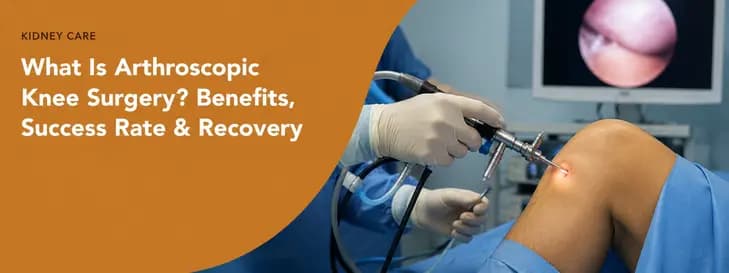
Arthroscopic knee surgery, also called arthroscopy, is a minimally invasive surgical procedure in which an orthopedic surgeon uses a small camera called an arthroscope to examine and treat problems inside your knee joint. The arthroscope, about the size of a pencil, is inserted through a small incision, allowing the surgeon to view the interior structures of your knee on a monitor.
This technique enables precise diagnosis and treatment with minimal tissue damage. Unlike traditional open knee surgery, which requires a large incision to access the knee joint, arthroscopy uses two or three small incisions typically less than half an inch long.
One incision allows the camera to enter, while others provide access for surgical instruments. The procedure can be performed under local, regional, or general anesthesia depending on the complexity and patient preference. Because of the smaller incisions, patients experience less bleeding, reduced scar tissue formation, and typically go home the same day or after an overnight stay.
Who Actually Needs Arthroscopic Knee Surgery?
Arthroscopy isn't the default treatment for every knee complaint, most mechanical knee problems still start with physiotherapy, bracing, and activity modification. Surgery becomes relevant when conservative treatment has been tried and specific structural damage is confirmed on MRI. The most common indications include:
| Condition | How Arthroscopy Helps |
|---|---|
| Torn meniscus (cartilage cushion) | Trims or repairs the torn portion to relieve locking, catching, and swelling |
| ACL/PCL ligament tears | Reconstructs the ligament using a graft to restore knee stability |
| Loose cartilage fragments | Removes floating debris causing pain or joint catching |
| Synovitis (inflamed joint lining) | Removes inflamed tissue (synovectomy) when medication hasn't helped |
| Patellar (kneecap) misalignment | Releases tight tissue to correct tracking and reduce recurring dislocation |
| Early-stage cartilage defects | Microfracture or cartilage regeneration techniques in select younger patients |
Benefits of Arthroscopic Knee Surgery Over Open Surgery
Compared with traditional open knee surgery, arthroscopy offers several well-documented practical advantages for eligible patients:
- Smaller incisions (often under 1 cm) mean less visible scarring and lower infection risk
- Reduced blood loss and less disruption to surrounding muscle and soft tissue
- Shorter hospital stay, many patients are discharged the same day or within 24 hours
- Faster return to walking, usually within a day, with crutches or a knee brace as needed
- Lower post-operative pain compared with open arthrotomy, meaning less reliance on strong painkillers
- Ability to both diagnose and treat the problem in a single procedure, avoiding a second surgery for confirmation.
These benefits apply most strongly to mechanical problems like meniscus tears and ligament injuries, the category where arthroscopy has the strongest evidence behind it, discussed next.
Arthroscopic Knee Surgery Success Rate: What the Evidence Actually Shows
Most health sites quote a single flat number for arthroscopic knee surgery success, usually somewhere around 90–95%, without saying which condition that number applies to. That's misleading, because outcomes vary sharply by diagnosis.
Meniscus and ligament procedures
For meniscal tears, published success rates typically range between 75% and 90%, with ligament reconstructions such as ACL repair often reporting success above 90% depending on graft type, technique, and patient age.
A meta-analysis in Cureus noted that meniscal repair failure rates climb to 9–27% in patients over 40, largely because older meniscal tissue has fewer reparative cells. Age and tear pattern matter as much as the surgeon's skill.
Osteoarthritis and degenerative knees; the honest caveat
For pure degenerative knee disease without a mechanical tear, the picture is far less favourable than most marketing pages suggest.
A 2025 Cochrane systematic review found that 82 out of 100 people reported treatment success after arthroscopic surgery for degenerative knee disease, compared with 74 out of 100 who had a placebo (sham) procedure, a gap Cochrane's reviewers judged too small to represent a clinically meaningful benefit (source).
In other words, for osteoarthritis alone, arthroscopy's edge over doing nothing surgical is modest at best, which is exactly why a careful MRI-based diagnosis, not just an X-ray showing "wear and tear," should come before anyone agrees to surgery.
The practical takeaway: ask your surgeon specifically what is being repaired, meniscus, ligament, cartilage flap, or loose body, and what evidence exists for that exact procedure. "Success rate" as a single number for "knee arthroscopy" in general isn't a meaningful figure to base a decision on.


What to Expect: The Procedure, Step by Step
- Pre-op workup: clinical examination, X-ray, and typically an MRI to confirm the exact structural problem
- Anaesthesia: spinal or general anaesthesia, decided with the anaesthetist based on your health profile
- Access: 1–2 small portals (incisions) around the knee, through which the arthroscope and instruments enter
- Diagnosis and treatment: the surgeon inspects the joint on a monitor, then trims, repairs, or reconstructs as required, typically within 30–90 minutes
- Closure: portals are closed with a stitch or steri-strip each, and a compression bandage is applied
- Recovery room: most patients are up and walking with support the same day or the next morning
Recovery Timeline After Arthroscopic Knee Surgery
Recovery speed depends on what was repaired, a simple meniscus trim heals faster than an ACL reconstruction. As a general guide:
| Timeframe | What to Expect |
|---|---|
| 0–2 days | Hospital discharge (often same-day); walking with crutches or a brace |
| 1–2 weeks | Swelling reduces; light desk-based work often possible; physiotherapy begins |
| 3–6 weeks | Improved range of motion; walking without support for simple meniscus procedures |
| 6–12 weeks | Return to most daily and low-impact activities; ligament reconstructions still rehabilitating |
| 3–6 months | Full return to sport or high-impact activity for ligament reconstruction cases |
Structured physiotherapy is not optional, it's the single biggest factor separating a good outcome from a mediocre one. Patients who skip supervised rehab after ligament reconstruction have measurably worse stability outcomes, which is consistent with findings from broader arthroscopic surgery outcome research on post-operative range of motion.
How to Choose the Right Hospital for Knee Arthroscopy
- A dedicated orthopaedic/arthroscopy specialist, not a general surgeon occasionally performing knee procedures
- MRI and imaging facilities in-house, so the diagnosis isn't outsourced and delayed
- Transparent discussion of when surgery is not indicated, not just when it is
- Structured post-op physiotherapy support, ideally on the same campus
- For NRI/Gulf patients: multilingual coordination, visa/travel assistance, and remote consultation options before you travel
- Clear, itemised cost estimates rather than vague "starting from" figures.
Choose Meitra Hospital for Knee Care
Choosing the right hospital for knee surgery is about more than finding an experienced orthopaedic surgeon. Patients often need access to accurate diagnosis, sports injury specialists, joint preservation procedures, advanced joint replacement options, rehabilitation, and coordinated care, all within the same healthcare system.
Meitra Hospital in Kozhikode has developed its orthopaedic programme with this integrated approach, making it a preferred choice for both patients across Kerala and international patients from the Gulf.
Key advantages include:
- First hospital in South Asia to introduce the Smith & Nephew CORI Surgical System for robotic-assisted knee replacement.
- Arthroscopy and robotic joint replacement available within the same orthopaedic centre.
- Dedicated International Patient Services with support in English, Malayalam, and Arabic.
- Pre-travel review of MRI scans and online consultations for Gulf patients.
- Comprehensive diagnosis, surgery, and rehabilitation without needing referrals to multiple hospitals.
This integrated approach makes Meitra a convenient option for patients across Kerala and the Gulf seeking advanced knee care.
Conclusion
Arthroscopic knee surgery is one of the more genuinely useful advances in orthopaedic care, but only when it's matched to the right diagnosis. Meniscus tears, ligament injuries, and loose cartilage fragments respond well; pure osteoarthritis, on its own, responds far less predictably than most patients are led to believe.
The best next step for anyone weighing this decision isn't to search for a single "success rate" number, but to get an MRI-based opinion from a surgeon willing to explain exactly what's damaged, what the realistic outcome looks like for that specific injury, and what recovery will actually demand of you.
Whether you're in Kozhikode, elsewhere in Kerala, or planning a visit from the Gulf, that conversation, more than any brochure, is what determines whether surgery is the right call.
Chat with our care assistant for a quick first read on your symptoms and reports, or to get in touch with Meitra Hospital's orthopaedic team to book an in-person or video consultation with the Centre for Bone, Joint & Spine.
Medical Disclaimer: This article is for general informational purposes only and does not constitute medical advice, diagnosis, or treatment. Success rates and recovery timelines cited are drawn from published clinical literature and may not reflect individual outcomes. Always consult a qualified orthopaedic surgeon to evaluate your specific condition, imaging, and medical history before making any treatment decision.