
Temporal lobe epilepsy (TLE) is the most common form of epilepsy in adults, often causing seizures that start in the brain's memory and emotion centers. When seizures continue despite trying multiple anti-seizure medications, surgery becomes an option worth serious consideration. This guide explains when and why your neurologist or neurosurgeon might recommend surgery, what the evaluation involves, and how the procedure can help you regain control of your life.
What Is Temporal Lobe Epilepsy, and Why Does It Often Resist Medication?
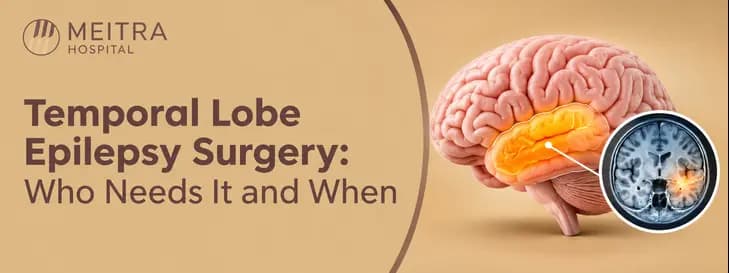
Temporal lobe epilepsy (TLE) is epilepsy in which seizures begin in the temporal lobe, the part of the brain involved in memory, emotion and language. It is the most common form of adult epilepsy that can be treated surgically.
Mesial and neocortical temporal lobe epilepsy
Doctors separate TLE by where in the temporal lobe seizures start. Mesial TLE arises deep inside, in structures such as the hippocampus, and is commonly linked to hippocampal sclerosis, a scarring and shrinkage of the hippocampus. Neocortical TLE arises on the outer surface. The distinction matters because it shapes the surgical plan and the expected outcome.
What temporal lobe seizures look like
Many people describe a warning, or aura, before the seizure: a rising sensation in the stomach, a sudden feeling of déjà vu, or unexplained fear. The seizure itself often involves staring, a loss of awareness, and repetitive movements such as lip-smacking or fumbling with the hands. Confusion can last minutes afterward.
Temporal lobe seizures with an abnormality on imaging are among those least likely to respond to drugs, which is why TLE is regarded as a surgically remediable epilepsy.
When Is Temporal Lobe Epilepsy Surgery Recommended?
Temporal lobe epilepsy surgery is recommended when seizures continue despite two appropriate, adequately dosed medicines and the evaluation shows they begin in one temporal region that can be safely removed or treated. Two failed medicines are the international definition of drug-resistant epilepsy.
| Factor | Points toward surgery | Needs more testing |
|---|---|---|
| Medicine history | Two appropriate medicines failed | Only one drug tried, or doses unclear |
| Seizure impact | Disabling seizures, injuries, lost work or driving | Rare, mild seizures |
| MRI | One-sided hippocampal sclerosis or other lesion | Normal MRI |
| EEG and seizure features | Agree with the MRI | Disagree, or both sides involved |
| General health | Stable and fit for surgery | Uncontrolled psychiatric illness, high surgical risk |
Agreement between tests is the key idea. Some patients with a one-sided MRI abnormality turn out to have seizures starting on both temporal lobes, which is why apparently ideal candidates are re-verified with further monitoring.
How Doctors Decide: The Presurgical Evaluation, Step by Step
No single test determines whether someone is a candidate for epilepsy surgery. Doctors combine findings from multiple evaluations to identify where seizures begin, assess potential risks, and determine whether surgery is likely to help.
-
Video-EEG monitoring: Records habitual seizures and helps identify where they originate in the brain. (Overview of epilepsy surgery evaluation)
-
3T epilepsy-protocol MRI: Looks for structural abnormalities, such as hippocampal sclerosis or other lesions that may cause seizures.
-
Neuropsychological testing: Evaluates memory, language, and other cognitive functions to estimate the potential risk of decline after surgery.
-
PET or SPECT scans: Provide additional information about seizure-related brain activity, particularly when MRI and EEG findings do not agree.
-
fMRI or Wada test: Helps determine which side of the brain supports language and, in selected cases, memory functions.
-
Multidisciplinary case conference: Neurologists, neurosurgeons, neuroradiologists, and neuropsychologists review the findings together to assess surgical candidacy and recommend the next steps.
When stereo-EEG is needed
If the non-invasive tests disagree, or the MRI is normal, doctors may place thin electrodes inside the brain through small drill holes to record seizures directly. This is stereo-EEG (SEEG), and it helps decide whether a clear surgical target exists. Not every patient needs it.
Also Read: Medication-Resistant Epilepsy: When Surgery Becomes the Best Option


Temporal Lobe Epilepsy Surgery at Meitra Hospital, Kozhikode
Meitra Hospital in Kozhikode, Kerala, operates an Advanced Epilepsy Centre designated Level-4, which Meitra describes as covering outpatient diagnosis, inpatient video-EEG monitoring, complex presurgical evaluation, surgical treatment including deep brain stimulation, and post-operative rehabilitation (Meitra epilepsy overview). For people in Malabar and for families abroad, this places the full evaluation pathway described above within one hospital.
Team and technology
- Neurology leadership: Dr. Sachin Sureshbabu, Head of Department of Neurology and Senior Consultant.
- Epilepsy specialists: Dr. Tushar V. P., Epileptologist, and Dr. Amrutha, supporting specialist evaluation and management.
- Epilepsy surgery: Dr. Nilesh Kurwal, Epilepsy Surgeon, involved in assessing suitable candidates for surgical treatment.
- Diagnostics: 3T MRI, PET imaging, high-resolution intraoperative CT and intraoperative EEG.
- Accreditation: JCI, NABH and NABL, with Meitra describing itself as the first hospital in Malabar to achieve JCI.
The first step is a review of existing reports, and it does not commit a patient to surgery. For the broader picture of epilepsy surgery options, chat with our medical assistant.
Conclusion
Temporal lobe epilepsy surgery is recommended when two appropriate medicines have failed and a careful evaluation shows seizures arising from one temporal region. The evidence supports it: randomized trials show far higher seizure freedom with surgery than with continued medication, and the main risks, visual field changes and memory decline, are known and discussed before any decision. The practical lesson is timing. Waiting years after the second drug failure delays the benefit, so a referral to an epilepsy centre for a full evaluation is the sensible next step for anyone whose seizures are still not controlled.
Chat with the Meitra assistant to share your reports and ask about an epilepsy evaluation.
Medical disclaimer: This article is for general information and education only. It is not medical advice and does not replace consultation with a qualified neurologist or neurosurgeon. Epilepsy treatment decisions require individual evaluation by a specialist. If you or a family member has recurrent seizures, please consult a licensed medical professional.