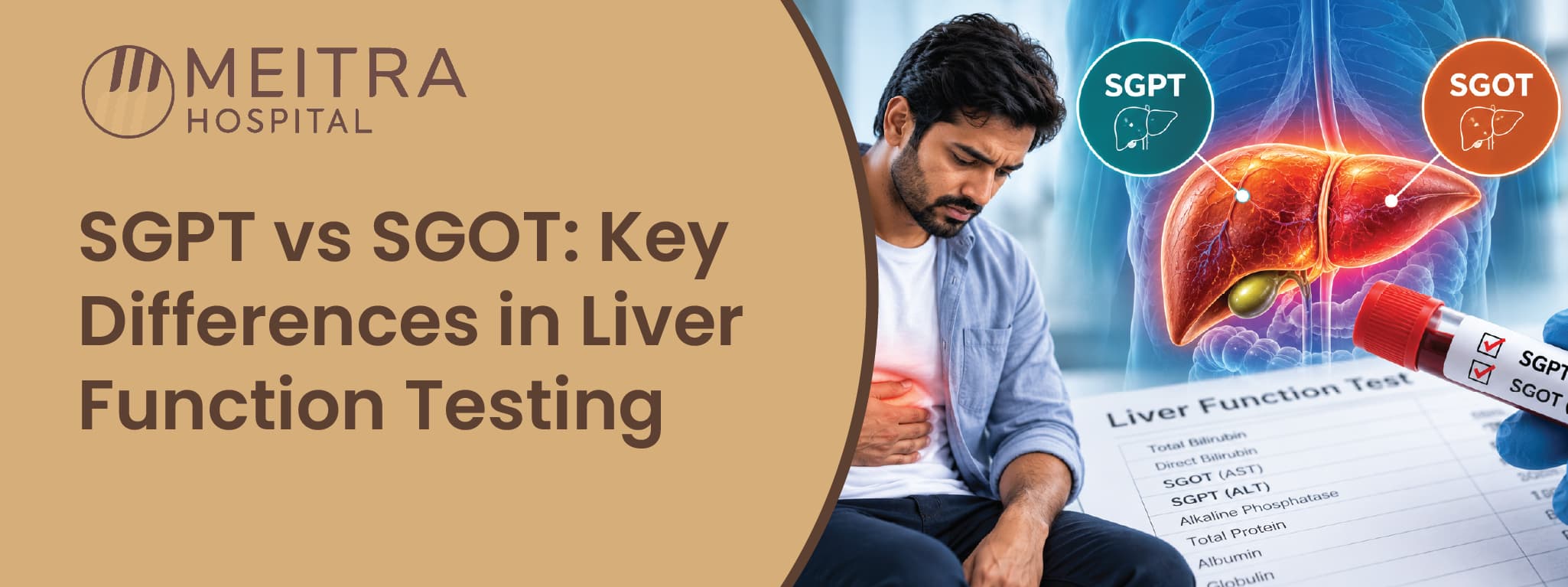

SGPT and SGOT are liver enzymes measured in blood tests to assess how well your liver is working. Though both enzymes come from liver cells, they differ in their location and what elevated levels may suggest about your health. Understanding these differences helps you make sense of your lab results and work with your doctor on next steps.
SGPT vs SGOT: The Short Answer
SGPT (ALT) is found mostly in liver cells, so a raised level points towards the liver. SGOT (AST) is found in the liver but also in muscle, heart and kidney, so a raised level needs wider interpretation. Doctors compare the two as the AST/ALT ratio to narrow down the cause.
What Are SGPT and SGOT? A Simple Introduction
SGPT and SGOT are two enzymes (proteins that speed up chemical reactions) found inside liver cells. SGPT stands for serum glutamic-pyruvic transaminase, while SGOT stands for serum glutamic-oxaloacetic transaminase. When liver cells are damaged or stressed, these enzymes leak into your bloodstream, raising their levels in a blood test. Your doctor measures both to get a fuller picture of liver health. Neither test diagnoses a specific disease on its own, but together with other information, they help your doctor understand if your liver needs attention. Think of them as warning signals that alert your doctor to investigate further.
SGPT vs SGOT: Key Differences
| Feature | SGPT (ALT) | SGOT (AST) |
|---|---|---|
| Specificity | A rise points mainly to the liver | A rise may come from liver, muscle or heart |
| Usual pattern in fatty liver | Often higher than AST | Usually lower than ALT |
| Pattern in heavy alcohol use | Often modestly raised | Often rises more than ALT |
| After intense exercise or muscle injury | May rise, usually less | Often rises more |
| Heart conditions | Not a heart marker | Can be released in a heart attack |
| Best use | First-line pointer to liver cell injury | Interpreted alongside ALT, never alone |
Normal Range: Lab Report vs Healthy Range
Most Indian labs flag ALT above roughly 56 U/L and AST above roughly 40 U/L. Those printed limits come from reference populations that include many people who already have undiagnosed fatty liver, which pushes the "normal" ceiling upward.
The ACG guideline takes a stricter view. It defines a truly healthy ALT as 29-33 IU/L for men and 19-25 IU/L for women, and states that a normal ALT does not exclude significant liver disease. The same guideline calculates that applying slightly lower cut-offs to US national survey data would classify 36% of men and 28% of women as having an elevated ALT, which shows how many apparently healthy adults sit above the ideal.
| Reading | Typical lab-printed limit | ACG healthy ALT |
|---|---|---|
| Men | Up to about 40-56 U/L | 29-33 IU/L |
| Women | Up to about 35-56 U/L | 19-25 IU/L |
In practice, an ALT of 45 may be "normal" on the report and still be worth a conversation if you have a larger waist, diabetes or high blood pressure. Context decides, not the flag alone.
AST/ALT (De Ritis) Ratio: Reading the Pair
Divide SGOT by SGPT and you get the AST/ALT or De Ritis ratio. Described in the 1950s, it remains a simple way to separate patterns of liver injury. It is a clue, never a diagnosis.
| AST/ALT ratio | Pattern often seen | Caution |
|---|---|---|
| Below 1 | Fatty liver; chronic viral hepatitis | Reassuring only if absolute values are modest |
| Around 1 or above in fatty liver | May suggest scarring (fibrosis) or cirrhosis | A classic study linked a ratio above 1 in non-alcoholic disease to cirrhosis; needs imaging to confirm |
| Above 2 | Classically alcohol-related liver disease | Muscle injury can do the same; GGT and creatine kinase help separate them |
The size of the rise matters as much as the ratio. A ratio of 2.5 with both enzymes barely above the limit means something very different from the same ratio at ten times the limit. If your report shows an AST/ALT ratio above 1, bring it to a gastroenterologist rather than interpreting it alone.
Why SGOT Can Be High When the Liver Is Fine
Because AST is not confined to the liver, several non-liver situations can lift it:
- Strenuous exercise. A study of healthy men found that muscular exercise can cause markedly abnormal liver test results. A heavy gym session or long run the day before a blood draw can distort AST more than ALT.
- Muscle injury or breakdown. A high AST with a normal ALT is a prompt to check creatine kinase.
- Heart problems. AST can be released during a heart attack, which is why unexplained AST rises are sometimes reviewed together with cardiac tests.
- Medicines and supplements. Painkillers, statins and some antibiotics can affect liver enzymes; herbal products too.
A practical step: avoid hard workouts for a day or two before the test, and carry a list of every medicine and supplement you take.
What Pushes SGPT Up? Common Causes
- Fatty liver. Fat build-up from excess weight, diabetes or high cholesterol is the most common cause of mildly raised transaminases. Since 2023 the term NAFLD has been replaced by MASLD (metabolic dysfunction-associated steatotic liver disease), diagnosed when fat in the liver coexists with at least one of five cardiometabolic risk factors.
- Alcohol. The same consensus created a MetALD category for people with metabolic risk factors who also drink above set weekly limits.
- Viral hepatitis B and C. Often silent for years; enzymes may be the only hint.
- Medicines and supplements. Review everything you take, including over-the-counter products.
- Other causes. Autoimmune hepatitis, haemochromatosis, coeliac disease and gallbladder or bile duct problems can also raise enzymes.


How High Is Too High?
The ACG groups elevations by how many times they exceed the upper limit of normal (ULN), from borderline to massive. A simplified version:
| Category | ALT/AST level | What it usually prompts |
|---|---|---|
| Borderline | Under 2 x ULN | Repeat the test; review weight, alcohol, medicines |
| Mild | 2-5 x ULN | Targeted work-up for fatty liver, viral hepatitis and drug causes |
| Moderate | 5-15 x ULN | Prompt specialist evaluation |
| Severe | Over 15 x ULN | Urgent evaluation; acute injury is possible |
| Massive | Over 10,000 IU/L | Emergency care |
What Happens After an Abnormal Result?
The ACG recommends a stepwise approach rather than treating the number in isolation. In a typical hospital pathway:
-
History first. Alcohol intake, medicines, supplements, weight change, family history and recent illness.
-
Repeat with a wider panel. ALT and AST again, plus GGT, ALP, bilirubin, albumin and clotting tests.
-
Rule out infection. Hepatitis B and C screening.
-
Look at the liver. Ultrasound and, where available, a liver stiffness measurement to check for scarring.
-
Specialist review. A gastroenterologist or hepatologist combines the results and decides on treatment or monitoring.
How Meitra's Centre for Gastrosciences Reads Raised SGPT and SGOT
A blood test tells you that something is irritating the liver. The harder question is why, and whether the liver has already been scarred. That is where a hospital-based evaluation differs from a standalone lab report.
Who reviews your report
The Centre for Gastrosciences at Meitra Hospital, Kozhikode treats disorders of the digestive system, liver and pancreato-biliary tract. Medical gastroenterology is led by Dr. Mohamed K (HOD and Senior Consultant, DM Gastroenterology), alongside Dr. Jijo V. Cherian (Medical Director and Senior Consultant, who also directs endoscopy services). Dr. Rohit Ravindran heads GI surgery, and Dr. Jubin Kamar covers paediatric gastroenterology.
What a complete evaluation can include
| Step | What Meitra lists on its website |
|---|---|
| Specialist clinic | Gastrointestinal and Hepatopancreatic Clinic, with outpatient consultation |
| Imaging | 3T MRI and 128-slice CT scanners, with interventional radiology support |
| Endoscopy | Therapeutic endoscopy; round-the-clock emergency consultation and endoscopy |
| Diet and lifestyle | Clinical Nutrition and Dietetics, relevant because most raised enzymes trace back to fatty liver |
| Preventive screening | Preventive health packages and in-house laboratory services |
When it goes beyond medication
Most mildly raised enzymes are managed with lifestyle change and monitoring. If scarring or advanced disease is found, the same campus offers GI and hepatobiliary surgery and liver transplantation, with Dr. Karthik Mathivanan listed as Senior Consultant and Liver Transplant Surgeon. Having these teams under one roof means the opinion that follows an abnormal report does not require moving the patient between hospitals.
For patients from other states and countries
Meitra's website is available in English, Malayalam and Arabic, and it has a dedicated international patient page for travellers. Patients can start by sharing their existing reports through the contact page so the team can advise whether a visit is needed.
Understanding costs before you visit
Meitra publishes price lists such as stent prices and knee implant rates on its website, an unusual level of transparency for Indian hospitals. For liver evaluations, ask the team for an estimate of consultation, tests and imaging in advance so there are no surprises. Early evaluation is usually the lower-cost route: a borderline result caught now is far simpler to manage than advanced liver disease later.
When to See a Doctor Urgently
Do not wait for a repeat test if raised enzymes come with any of the following:
- Yellowing of the skin or eyes, or dark urine
- Pain in the upper right abdomen, or a swollen abdomen
- Black or bloody stools, or vomiting blood
- Confusion, extreme drowsiness or persistent vomiting
Conclusion
SGPT and SGOT are best read as a pair, not as two separate scores. SGPT (ALT) points to the liver more precisely; SGOT (AST) tells you more only when matched against ALT, symptoms and your history. Remember that a report can print "normal" while still sitting above the healthy ALT range suggested by ACG, and that a hard workout can raise SGOT without any liver problem.
If your result is flagged, repeat it, review your medicines and alcohol intake, and ask for an evaluation that looks at the cause, not just the number.
Share it with Meitra's Centre for Gastrosciences. Contact us or Chat with Meitra Assistant to ask your first questions now.
Medical disclaimer: This article is for general information and does not replace advice from a qualified doctor. Reference ranges differ between laboratories, and results must be interpreted with your symptoms and history. Do not start or stop any treatment based on this page. If you have symptoms or an abnormal report, consult a physician.